
TerraVision
By patrickchugh·1,638
Cloud architecture diagrams with official AWS, Azure and GCP icons, from Terraform or a JSON graph.
 TerraVision
Turn Terraform or JSON into professional cloud architecture diagrams in official AWS, Azure and GCP style







Ask your AI assistant for a cloud architecture diagram, in plain words, and get the diagram a cloud architect would draw: the official AWS, Azure and GCP icons, with every resource in its VPC, subnet, zone or resource group. From a description, from your Terraform code, or the other way round, with the Terraform written from the diagram. TerraVision runs on your own computer and needs no cloud access.
Get started with your AI assistant
1. Install the prerequisites (once)
TerraVision needs Graphviz (to draw), Git and uv (which runs TerraVision for your assistant). Terraform is only needed to draw from Terraform code.
macOS
With Homebrew:
brew install graphviz git uv
brew install hashicorp/tap/terraform   # optional: to draw from Terraform code
Windows
In PowerShell:
winget install --id Graphviz.Graphviz -e
winget install --id Git.Git -e
winget install --id astral-sh.uv -e
winget install --id Hashicorp.Terraform -e   # optional: to draw from Terraform code
Then open a new terminal, and restart your AI app, so they see the new programs.
Linux (Debian, Ubuntu)
sudo apt install graphviz git
curl -LsSf https://astral.sh/uv/install.sh | sh
On Ubuntu 26.04+ and Debian testing, also sudo apt install libgvplugin-neato-layout8. For Terraform, see HashiCorp's install guide.
2. Connect your assistant
Claude Desktop: download terravision-<version>.mcpb from the latest release and open it (or drag it into Settings → Extensions). Diagrams appear right in the chat, with buttons to open the image, edit it in draw.io, show it in its folder and see its source.
Claude Code (terminal, VS Code or JetBrains):
claude plugin marketplace add patrickchugh/terravision
claude plugin install terravision-cloud-diagrams@terravision
Then start a new Claude Code session. Diagrams are saved in a diagrams folder in your project.
OpenAI Codex CLI:
codex plugin marketplace add https://github.com/patrickchugh/terravision
codex plugin add terravision-cloud-diagrams@terravision
Gemini CLI:
gemini extensions install https://github.com/patrickchugh/terravisionVS Code with GitHub Copilot, Cursor and other MCP clients: add TerraVision as an MCP server that runs uvx --from "terravision[mcp]" terravision mcp --output-dir <folder for diagrams>. The setup guide has the configuration for each.
3. Ask for a diagram
| You have | Ask something like | You get |
|---|---|---|
| An idea | "Draw an AWS three-tier app: React on CloudFront, ECS Fargate behind an ALB in two AZs, SQL Server on RDS Multi-AZ" | The diagram (PNG, SVG, editable draw.io) and its graph. Refine it by asking: "add ElastiCache", "show how a request flows through it" |
| Terraform code, local or on GitHub | "Draw the architecture of the Terraform in ./infra" or "Show me a cloud architecture diagram of https://github.com/patrickchugh/testcase-bastion//examples" | A diagram of what terraform plan says the code deploys |
| A diagram you like | "Write the Terraform for this architecture" | Terraform for the resources, zones and connections, with the diagram's flows and labels kept |
| Terraform in a repository | "Keep this diagram up to date in CI" | A workflow that redraws the diagram whenever the Terraform changes |
The first diagram takes a little longer while TerraVision installs itself. If anything is missing, the assistant says what to install. To check at any time, ask: "Is TerraVision set up correctly?"
The full guide, with more example prompts: Use TerraVision with AI assistants.
Keep diagrams current in CI/CD
Point the TerraVision GitHub Action at your Terraform, and the diagram redraws itself on every change:
- uses: hashicorp/setup-terraform@v3
- uses: patrickchugh/terravision-action@v2
  with:
    source: ./infrastructure
    outfile: docs/architecture
    format: both
A terravision.yml next to the Terraform adds the title, numbered flows and connection labels to every version. GitLab, Jenkins, Azure DevOps and others: CI/CD Integration.
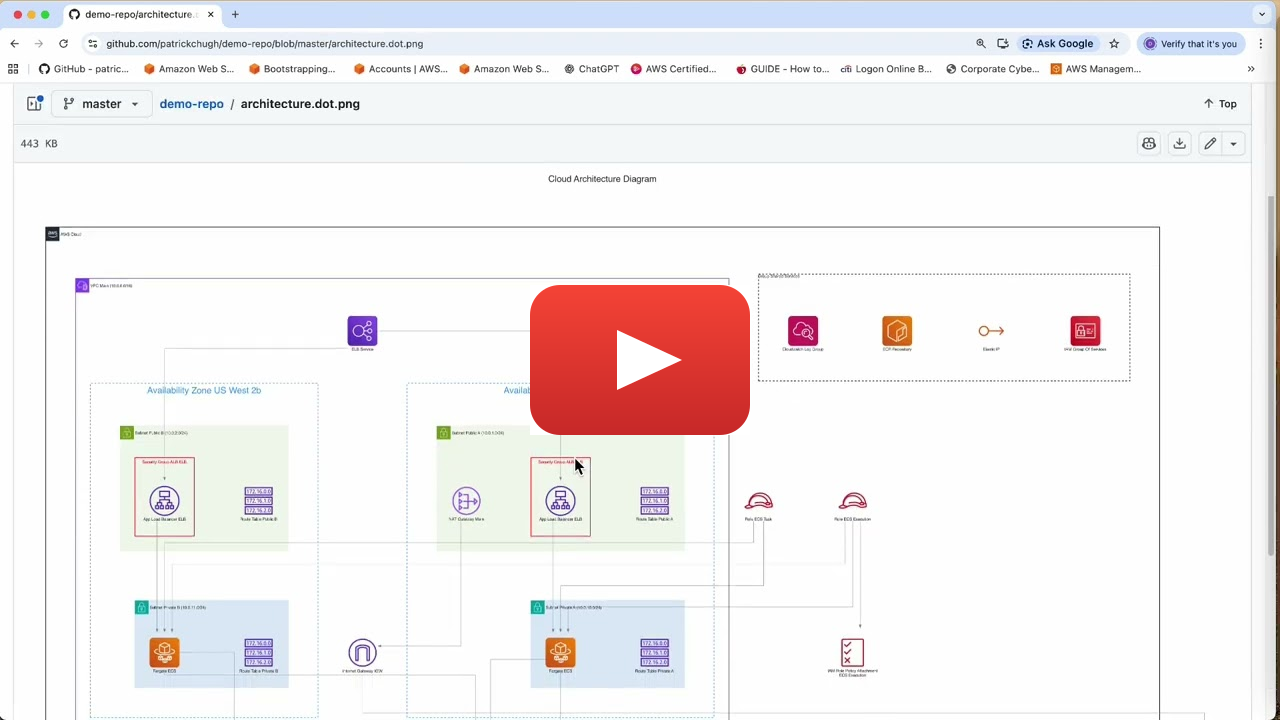
Watch a 4-Minute Intro
Why TerraVision?
- ✅ Built for AI assistants — an MCP server and agent skill for Claude, Codex, Gemini, Copilot and Cursor; diagrams appear right in the chat in Claude Desktop (guide)
- ✅ JSON graph input — describe an architecture in a few lines of JSON and render it, resources match Terraform names so no need to learn a custom DSL (Graph Format)
- ✅ Always up-to-date — diagrams generated directly from your Terraform code
- ✅ 100% client-side — no cloud access required, runs locally, your code never leaves your machine
- ✅ CI/CD ready — automate diagram updates on every PR merge
- ✅ Free & open source — no expensive diagramming tool licenses
- ✅ Multi-cloud — AWS (full), GCP, and Azure (core services)
- ✅ Interactive HTML output — clickable nodes, pan/zoom, search, animated data flow
- ✅ Editable draw.io export — open in draw.io, Lucidchart, or any mxGraph editor
- ✅ Optional AI annotations — labels, titles, and flow sequences from Ollama (local) or AWS Bedrock
- ✅ Terragrunt compatible — auto-detects single- and multi-module Terragrunt projects
- ✅ MCP server and agent skill — let AI agents generate diagrams from a JSON graph or your Terraform, see the guide
Supported Cloud Providers
| Provider | Status | Resource types |
|---|---|---|
| AWS | ✅ Full support | 385 types |
| Google Cloud | ✅ Full support | 264 types |
| Azure | ✅ Full support | 245 types |
Full list: Node types.
Use it from the command line
TerraVision is also a command-line tool, for scripts and for people who prefer to write the graph themselves.
Install
pipx install terravision   # or: uv tool install terravision
                           # or: pip install terravision in a virtual env
You also need Python 3.11+ (uv installs one for you), Graphviz and Git, plus Terraform 1.x (or OpenTofu) when drawing from Terraform code; JSON graphs don't need it. See the Installation Guide for platform-specific instructions, Docker, and Nix.
Diagram from JSON (no Terraform needed)
Describe the architecture as nodes and connections. AWS is shown here; expand the Azure and GCP examples below.
{
  "tv_aws_users.users": ["aws_cloudfront_distribution.cdn"],
  "aws_cloudfront_distribution.cdn": ["aws_s3_bucket.static_site", "aws_alb.api"],
  "aws_vpc.main": ["aws_subnet.public~1", "aws_subnet.private~1"],
  "aws_subnet.public~1": ["aws_alb.api"],
  "aws_subnet.private~1": ["aws_lambda_function.orders"],
  "aws_alb.api": ["aws_lambda_function.orders"],
  "aws_lambda_function.orders": ["aws_dynamodb_table.orders", "aws_sqs_queue.events"]
}
Azure example
{
  "tv_azurerm_users.users": ["azurerm_cdn_frontdoor_profile.edge"],
  "azurerm_cdn_frontdoor_profile.edge": ["azurerm_linux_web_app.api"],
  "azurerm_resource_group.app": ["azurerm_virtual_network.main", "azurerm_mssql_database.orders", "azurerm_servicebus_queue.events", "azurerm_key_vault.secrets"],
  "azurerm_virtual_network.main": ["azurerm_subnet.app"],
  "azurerm_subnet.app": ["azurerm_linux_web_app.api"],
  "azurerm_linux_web_app.api": ["azurerm_mssql_database.orders", "azurerm_servicebus_queue.events", "azurerm_key_vault.secrets"]
}
GCP example
{
  "tv_gcp_users_icon.users": ["google_compute_global_forwarding_rule.lb"],
  "google_compute_global_forwarding_rule.lb": ["google_cloud_run_v2_service.api"],
  "google_cloud_run_v2_service.api": ["google_sql_database_instance.orders", "google_pubsub_topic.events", "google_storage_bucket.assets"],
  "google_pubsub_topic.events": ["google_cloudfunctions2_function.worker"]
}
Render it:
terravision draw --source architecture.tvg.json --format svgEach key is <terraform_resource_type>.<name>; each value is what it connects to or contains. That is the whole format. Full spec, schema and more examples: Graph Format. Works for AWS (aws_*), Azure (azurerm_*) and GCP (google_*).
Diagram from Terraform
git clone https://github.com/patrickchugh/terravision.git
cd terravision

# EKS cluster example
terravision draw --source tests/fixtures/aws_terraform/eks_automode --show

# Azure VM scale set
terravision draw --source tests/fixtures/azure_terraform/test_vm_vmss --show

# From a public Git repo (note the // for subfolder)
terravision draw --source https://github.com/patrickchugh/terraform-examples.git//aws/wordpress_fargate --show
That's it — your diagram is saved as architecture-aws.dot.png (the provider is appended to the name) and opens automatically.
The diagram is derived from terraform plan, so it shows what the code actually deploys: conditionals, count, for_each and modules are resolved. Eraser and friends draw what the AI imagines; TerraVision proves what the code deploys.
Generate an interactive HTML diagram
terravision visualise --source ./path-to-your-terraform --showClick any resource to see its Terraform metadata, search resources, pan/zoom, and watch animated data flow on edges. The HTML is a single self-contained file that works fully offline.
Try the Interactive Demos
Click any of these to see the interactive HTML output TerraVision produces:
- 🟧 AWS demo — Wordpress on ECS Fargate with CloudFront, RDS, EFS
- 🟦 Azure demo — VM scale set with load balancer and VNet
- 🟩 GCP demo — Core GCP networking and compute
Basic Usage
Generate a diagram
# From a local directory
terravision draw --source ./path-to-your-terraform

# From a Git repository
terravision draw --source https://github.com/user/repo.git

# Custom format and filename
terravision draw --source ./path-to-your-terraform --format svg --outfile my-architecture

# Editable draw.io file
terravision draw --source ./path-to-your-terraform --format drawio --outfile my-architecture
Use a pre-generated Terraform plan (no cloud credentials needed)
# Step 1: in your Terraform environment
terraform plan -out=tfplan.bin
terraform show -json tfplan.bin > plan.json
terraform graph > graph.dot

# Step 2: diagram generation, no Terraform or cloud access required
terravision draw --planfile plan.json --graphfile graph.dot --source ./path-to-your-terraform
AI-powered annotations (optional)
terravision draw --source ./path-to-your-terraform --ai-annotate ollama   # local LLM (no data leaves your machine)
terravision draw --source ./path-to-your-terraform --ai-annotate bedrock  # AWS Bedrock via boto3 (uses your AWS credentials)
terravision draw --source ./path-to-your-terraform --ai-annotate restapi  # any OpenAI-compatible endpoint (OpenAI, LiteLLM, vLLM, ...)
Only metadata and the summary graph are sent to the LLM — never your .tf source. The bedrock backend authenticates via the standard AWS credential chain (no infrastructure to deploy); restapi is configured via TV_RESTAPI_URL, TV_RESTAPI_KEY, and TV_RESTAPI_MODEL. See the Annotations Guide and AI-Powered Annotations for the full configuration.
Simplified view
terravision draw --source ./path-to-your-terraform --simplifiedStrips VPCs, subnets, and networking plumbing. Great for executive presentations.
Common options
terravision --help shows full help text details.
| Option | Description | Example |
|---|---|---|
--source |
Terraform directory or Git URL | ./path-to-your-terraform |
--format |
Output format: png, svg, pdf, drawio, and more |
svg |
--outfile |
Output filename | my-architecture |
--workspace |
Terraform workspace | production |
--varfile |
Variable file (repeatable) | prod.tfvars |
--planfile |
Pre-generated plan JSON | plan.json |
--graphfile |
Pre-generated graph DOT | graph.dot |
--ai-annotate |
AI annotation backend | ollama, bedrock, restapi |
--simplified |
High-level view (no networking) | (flag) |
--show |
Open after generation | (flag) |
Documentation
The complete documentation lives at patrickchugh.github.io/terravision.
For users:
- Installation Guide
- Usage Guide
- Annotations Guide
- CI/CD Integration
- MCP Server Guide
- llms.txt (docs index for AI agents)
- FAQ
- Troubleshooting
For contributors:
FAQ
Common questions — cloud credentials, LLM data privacy, offline use, Terragrunt, output formats, and more — are answered in the FAQ on the documentation site.
Contributing
Contributions are very welcome. See CONTRIBUTING.md for development setup, coding standards, and the PR process.
Support
- Issues: GitHub Issues
- Discussions: GitHub Discussions
- Documentation: patrickchugh.github.io/terravision
License
See LICENSE.
Acknowledgments
- Graphviz — diagram rendering
- Terraform — infrastructure parsing
- Terragrunt — multi-module orchestration
- Cloud provider icons from official AWS, GCP, and Azure icon sets